

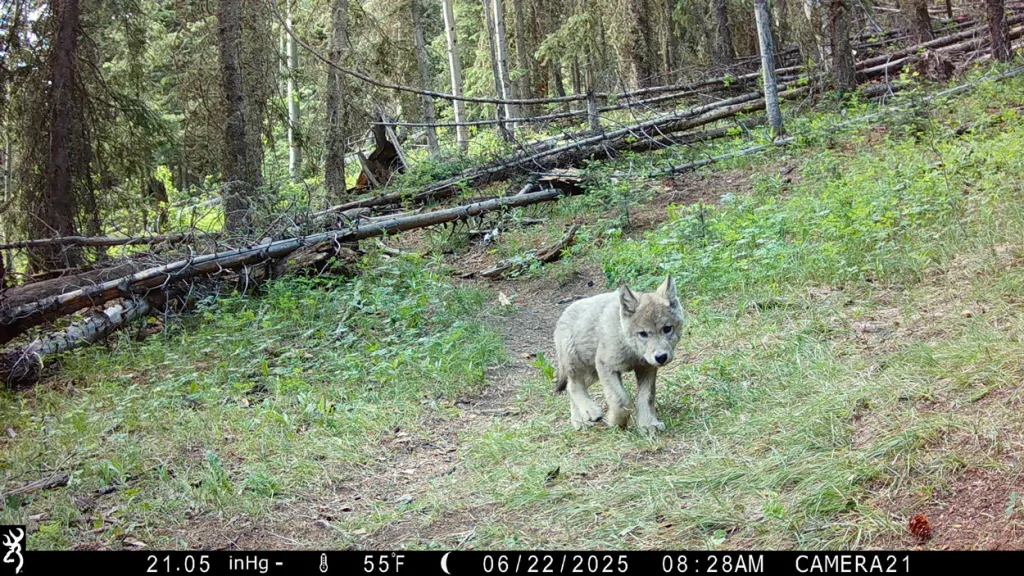
The gray wolf reintroduction in Colorado just added a new pack and its first litter of pups in three straight years.
Gray wolf reintroduction in Colorado reached a new milestone this summer. State biologists confirmed a new pack, called the Piney Ridge Pack, has formed in Eagle County. Four packs across the state successfully raised pups this spring.
Colorado Parks and Wildlife did not report exact pup counts, since young wolves are hard to track early on. Litters typically run between four and six pups, so growth could be significant.
Piney Ridge joins three other reproducing packs this year. They are One Ear in Jackson County, Three Creeks in Rio Blanco County, and Copper Creek, the first pack formed.
This marks the third straight year of successful wolf reproduction in the state. The gray wolf reintroduction in Colorado began after voters approved the plan in 2020. Wildlife officials began releasing wolves in December 2023, and steady pup production shows the program is taking hold.
Colorado voters passed the measure as Proposition 114, now written into state law. It directed wildlife officials to release wolves west of the Continental Divide. The first ten wolves came from Oregon, followed by a group of fifteen from British Columbia.
Eric Odell leads the state wolf conservation program. He explained that spotting new pups takes patience and skill. Young wolves stay hidden in cover and often remain underground for weeks.
Not every pack fared well this year. The King Mountain Pack lost both breeding wolves, one in January and one in March. The January death happened during a routine collaring effort, while the March death remains under review.
Even without new pups, the King Mountain wolves have not disappeared. Four yearlings from the pack still travel together across familiar territory, and officials still count them as an established pack.
Colorado’s wolf population had vanished by the 1940s, trapped and hunted out. The gray wolf reintroduction in Colorado aims to bring that missing predator back to its native range.
Roughly two dozen wolves had been released into Grand, Summit, Pitkin, and Eagle counties by early 2025. That steady approach has helped the population grow without overwhelming any single area.
Growing pack numbers matter for the whole landscape. Wolves help balance elk and deer populations, easing pressure on native plants. That can mean healthier streams, more beavers, and stronger bird habitat.
Scientists call this ripple effect a trophic cascade, meaning changes at the top of the food chain shift conditions below. Fewer elk grazing in one spot lets willows and aspen recover, supporting more insects, fish and songbirds.
Colorado’s program draws on lessons learned elsewhere. It echoes a similar effort carried out in Yellowstone National Park three decades ago. That effort is often cited as a conservation success story, since wolves there helped restore elk migration and revegetate riverbanks.

Gray wolf reintroduction in Colorado continues to take hold as new packs establish territory across the state’s wild landscapes. Photo courtesy of Colorado Parks & Wildlife.
Ranchers in wolf territory have raised ongoing concerns about livestock safety. State wildlife managers continue working with landowners to reduce conflicts through compensation programs and non-lethal deterrents.
Pack names come from nearby geographic features rather than exact den sites. This protects denning areas from added disturbance while keeping public attention on each pack’s broader territory.
State wildlife officials plan to share more details soon. A full population count is expected in next spring’s annual report, including statewide minimum numbers for wolves.
Wolf sightings have also sparked new interest in wildlife watching. Visitors and locals have started tracking pack territories from a respectful distance. That curiosity brings added attention, and sometimes revenue, to rural communities near wolf country.
Conservation groups have partnered with state agencies throughout the process, helping track packs and share updates with the public. That collaboration keeps residents informed as the wolf population expands.
Community meetings between ranchers, officials and conservationists have become more common too, aiming to find practical solutions before conflicts arise. Building trust between neighbors with different priorities takes time, but early signs point in a hopeful direction.
Each new litter brings Colorado closer to a fully self-sustaining wolf population. That goal has driven the gray wolf reintroduction in Colorado since voters approved it. Steady pup counts each spring point in the right direction.
Colorado’s wolves are part of a larger story of ecosystems bouncing back worldwide, echoing other rewilding success stories. A single restored species can benefit an entire landscape.
Five wolf packs now call Colorado home, and four of them are already raising the next generation. Gray wolf reintroduction in Colorado is proving to be a group effort, one the wolves themselves seem to be embracing. Every new pup adds a little more strength to a population working hard to take root.


