

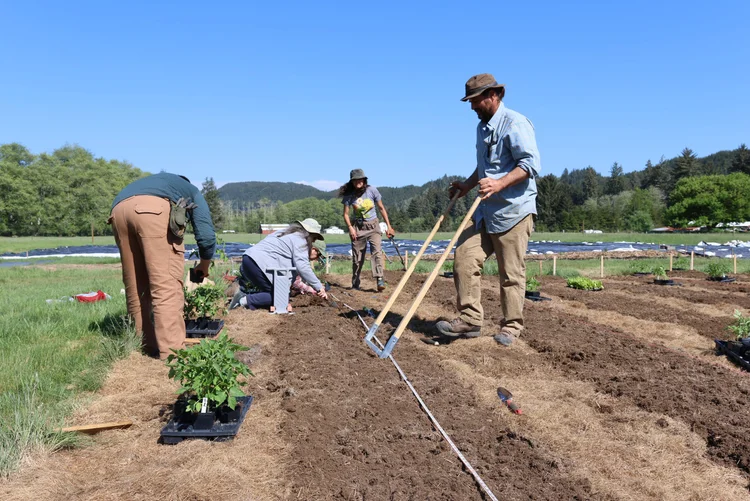
The Center for Rural Livelihoods is building socially just rural communities from Cottage Grove, Oregon, through agroforestry, restoration forestry, cooperative economics, and a new fellowship program.
The Center for Rural Livelihoods (CRL) builds socially just rural communities from its 40-acre campus in Cottage Grove, Oregon. The group has worked from this site since 1981. Its programs blend agroforestry, cooperative economics, and restoration forestry.
CRL recently published its first Agroforestry Handbook, a free planning guide for farmers and foresters. The handbook explains six agroforestry systems, including silvopasture and forest farming. Producers across Oregon and Washington can use it to plan tree-based farms suited to their own land.
Agroforestry mixes trees with crops, livestock, or both on the same piece of land. The practice can boost soil health, store carbon, and diversify a farm’s income. Indigenous communities across the Pacific Northwest have used similar methods for generations.
CRL’s own campus demonstrates these methods in daily practice. Forty acres of oak woodland, waterways, and gardens support hands-on learning there. Visitors can tour restoration forestry plots, agroforestry demonstrations, and on-site natural building projects.
A residential program offers some participants a longer path into this work. Residents can stay for up to two years while incubating small businesses or nonprofit projects. Many go on to start their own mission-aligned ventures in other rural towns.
Community Supported Forestry gives the campus’s forestlands a similar cooperative structure. Thirty-five acres of managed woods support both ecological restoration and shared learning. The approach treats forest stewardship as a communal responsibility rather than a private one.
Cooperative economics shapes much of CRL’s work beyond the campus fence. Its Community Educational Garden supplies fresh produce to a nearby food pantry. That pantry alone serves about 1,200 households in the Cottage Grove area each month.
Local farmers also benefit from CRL’s free technical support on silvopasture. Staff works with ranchers across the Willamette Valley to design tree-and-pasture systems. These partnerships extend the reach of socially just rural communities beyond CRL’s own fence line.

Socially just rural communities take shape through CRL’s cooperative economics model, from a Community Educational Garden supplying fresh produce to 1,200 households monthly at a local food pantry to free silvopasture technical support helping Willamette Valley ranchers design more sustainable tree-and-pasture systems. Photo courtesy of Center for Rural Livelihoods.
This fall, CRL is opening a new fellowship called Back from the Land. The free program invites participants to live and work on site for two or four weeks. Housing and meals are included for everyone who joins.
Each day includes several hours of hands-on labor across the working landscape. Fellows also choose one of two focus tracks. One track studies Cottage Grove itself, while the other examines organizing within universities.
The Cottage Grove track runs for four weeks and centers on one place. Participants study the town using several research tools before a final community gathering. The shorter university track runs two weeks and focuses on organizing within campus life.
Evening discussions draw on readings about social movements and rural organizing. The syllabus includes a forthcoming book by authors Naomi Klein and Astra Taylor. Sessions aim to connect land-based work with wider efforts toward social justice.
CRL’s founders trace part of their inspiration to the back-to-the-land movement of the 1970s. Thousands of communes formed during that decade as earlier social movements lost momentum. CRL frames its current programs as building on that history rather than repeating it.
Cottage Grove sits about 25 minutes from Eugene, in the southern Willamette Valley. The town has hosted CRL’s community activities for more than four decades. Local events, including a recent climate action town hall, help connect the group with area residents.
Support for the new Agroforestry Handbook came through a partnership with Agroforestry Northwest. Funding from the Western Sustainable Agriculture Research and Education program also backed the project. Together, these partners helped turn years of on-the-ground research into a shared regional resource.
Four decades of alumni have already carried lessons from Cottage Grove into other rural towns. Each new fellow adds to a growing network of socially just rural communities across the region. For CRL, tending the land and tending the community remain the same task.
Programs like the fellowship and the new handbook share one underlying goal. Both aim to give more people practical tools for regenerating land and local economies together. That combination is what keeps socially just rural communities growing beyond any single campus.


