

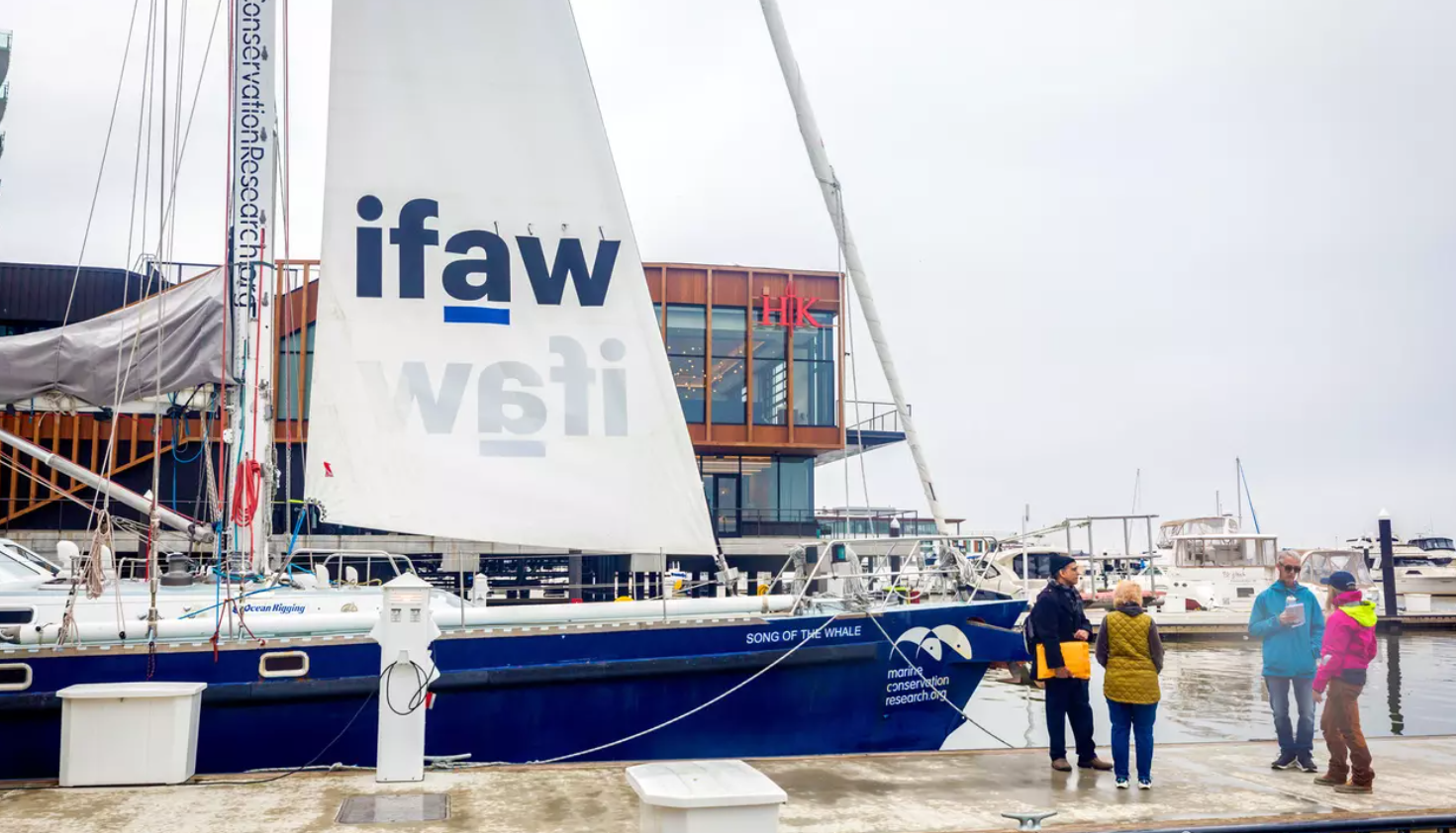
For nearly 40 years, the Song of the Whale research vessel has tracked whales using sound instead of harpoons, helping dismantle the case for so-called scientific whaling.
The Song of the Whale research vessel traces its origins to 1987, when the International Fund for Animal Welfare (IFAW) launched the project to develop non-invasive techniques for studying whales without killing them. At the time, some governments still argued that understanding whale biology required lethal sampling. The original vessel spent its early seasons around the Azores and Madeira in Portugal, documenting sperm whales in waters where 19th-century-style Yankee whaling persisted into the late 1980s.
Those early expeditions produced results that mattered beyond scientific curiosity. Working alongside local conservationists and academics, the Song of the Whale research vessel team promoted whale watching as a viable alternative to whaling in the Azores, even encouraging former whalers to become vigias, or lookouts, within the emerging tourism industry. Throughout the 1990s, seminal research conducted aboard the vessel helped demonstrate that Japan did not need to kill whales in the name of science, directly undermining one of the whaling industry’s central justifications.
The current Song of the Whale research vessel, a 70-foot cutter-rigged sailing ship, was purpose-built in 2004 to Lloyd’s Special Service Craft Rules, the first sailing vessel in three decades to meet that standard for worldwide service. Designed specifically for benign research techniques, including passive acoustic monitoring, the vessel carries advanced computerized recording and tracking equipment that allows scientists to detect whale vocalizations through hydrophones while minimizing disturbance to the animals themselves.
That design philosophy shapes everything about how the crew operates. The Song of the Whale moves quietly through the water, allowing acoustic surveys to continue even at night and in challenging sea conditions. This capability lets scientists follow whales over extended periods, document movement patterns, identify critical habitats, and gather evidence that directly informs conservation policy rather than relying on lethal sampling or brief, opportunistic sightings.
IFAW transferred ownership of the Song of the Whale research vessel to Marine Conservation Research International in 2014, expanding the organization’s capacity to pursue this mission independently while continuing close collaboration with IFAW on commissioned expeditions. Richard McLanaghan, who conceived the vessel’s original design and oversaw its build, now directs Marine Conservation Research after running Song of the Whale operations since 1992. Chief scientist Dr. Oliver Boisseau, who holds a doctorate from the University of Otago and has two decades of marine biology experience, joined the team in 2004 and has remained central to its research ever since.
In recent years, the Song of the Whale research vessel has focused intensively on North Atlantic right whales, one of the most critically endangered large whale species on Earth. Fewer than 350 individuals remain, including fewer than 70 reproductive females, placing the species on the edge of extinction. Changing distribution patterns have pushed these whales into areas along the Eastern Seaboard that currently lack protective measures, making updated survey data urgently necessary.
Throughout 2023, the Song of the Whale logged nearly 15,800 kilometers of survey effort along the eastern coast of the United States, recording 25 North Atlantic right whale group sightings comprising at least 32 individual whales, including two mother-calf pairs. The resulting report confirmed that vessel strikes and fishing gear entanglement remain chronic, persistent threats throughout the species’ habitat, providing concrete evidence to support expanded protective measures where whales are increasingly found.

In 2023, the Song of the Whale research vessel logged nearly 15,800 kilometers surveying critically endangered North Atlantic right whales, recording 32 individual whales and confirming vessel strikes and fishing gear entanglement remain chronic threats to the species’ survival. Photo by Andrea Spence, courtesy of IFAW.
Life aboard the Song of the Whale research vessel demands constant collaboration among a close-knit five-person crew, many of whom have worked together for years. Tasks blend seamlessly between scientific rigor and practical necessity: sailing the vessel, servicing sensitive equipment, standing round-the-clock whale watch, cooking meals, and cleaning living quarters all fall to the same small team. This shared commitment sustains month-long expeditions covering vast stretches of ocean.
The mission driving the research vessel extends beyond data collection alone. Crew members describe their work as inseparable from the broader goal of protecting whales directly, believing that improved understanding of movement patterns, health indicators, and behavioral responses translates into better-informed conservation decisions that can reduce the daily, life-threatening risks these animals face.
Nearly four decades after its founding mission to prove lethal whaling unnecessary for scientific understanding, the Song of the Whale research vessel continues demonstrating that careful, patient, non-invasive observation yields conservation insights that killing animals never could. As North Atlantic right whales edge closer to extinction and their ranges shift into unprotected waters, the vessel’s ongoing surveys provide exactly the kind of evidence policymakers need to expand protections before it becomes too late for a species with barely 70 breeding females left to sustain it.


