
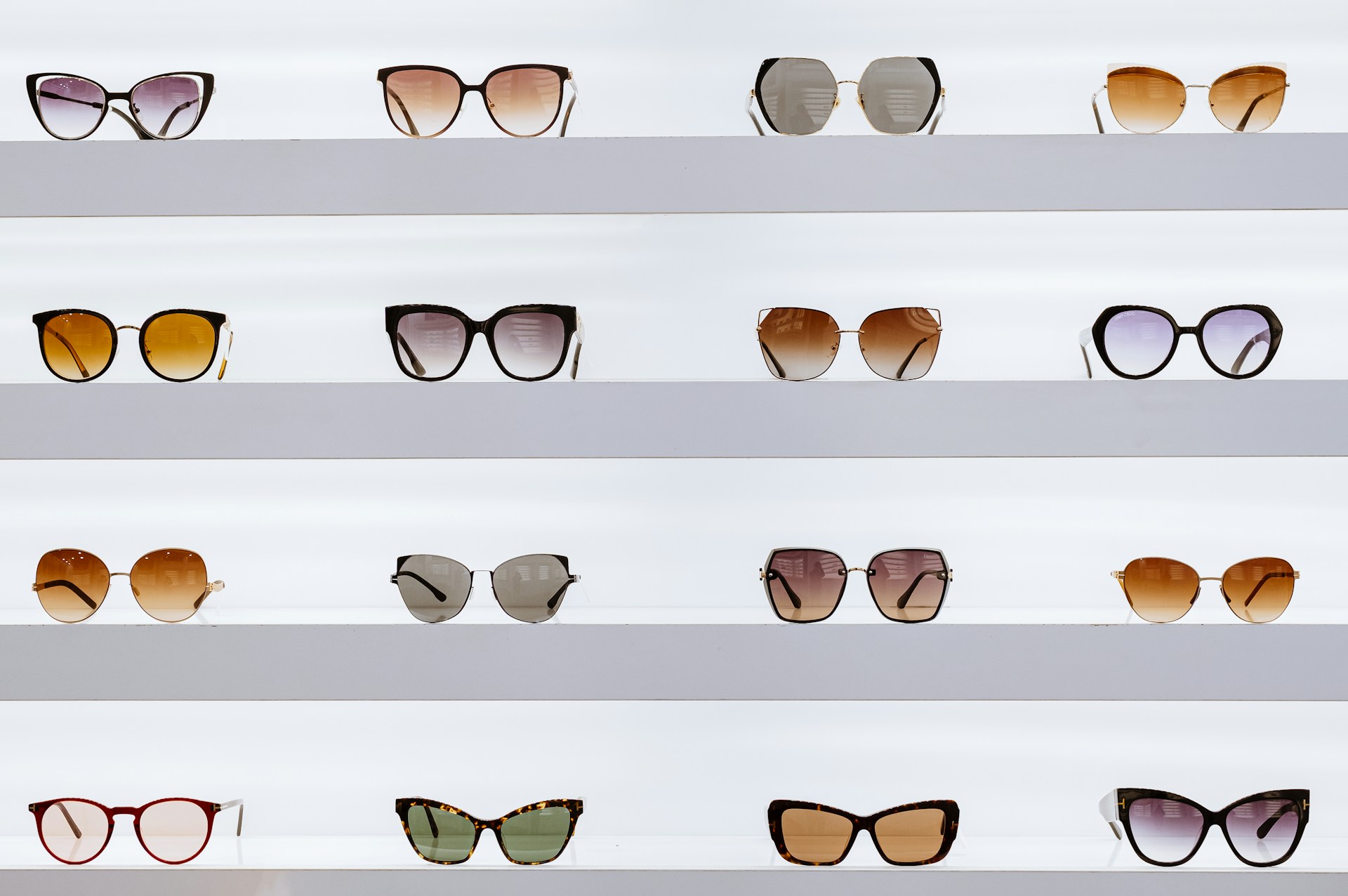
The economics of cheap sunglasses, and why the good ones stopped being expensive.
For about three decades, buying sunglasses meant confronting a strange price ladder. A $15 pair from a gas station on one end, a $250 pair from an optical shop on the other, and very little in between that felt worth the money. The gap was so consistent that most shoppers assumed it reflected some real difference in engineering. It mostly reflected one company’s grip on distribution.
Now a decent pair of polarized sunglasses costs $25 to $50 from a reputable seller, and the market for affordable prescription eyeglasses has followed the same curve. What used to feel like a status purchase feels like buying a toaster.
How Luxottica built the price ceiling
Most of the story runs through one Italian company. Luxottica, which merged with Essilor in 2018, owned Ray-Ban, Oakley, Persol, Oliver Peoples, and Sunglass Hut, and also manufactured licensed frames for Chanel, Prada, Versace, Burberry, Dolce and Gabbana, and Tiffany. One conglomerate controlled roughly 80 percent of the major eyewear brands sold in the United States and owned the largest retail chain selling them.
In a 2012 60 Minutes segment, the founder Leonardo Del Vecchio was asked about the pricing, and his answer was closer to a shrug than a defense. The margins were high because they could be. Independent optical shops that tried to negotiate found their supply of desirable brands quietly cut off.
The math was cruel and simple. A pair of Ray-Ban Wayfarers cost somewhere between $10 and $30 to make and retailed for $150 to $200. That spread paid for magazine ads, celebrity placements, and mall storefronts. It did not pay for meaningfully better optics.
What actually makes a pair worth wearing
Strip away the branding and sunglasses do three jobs: block UV, cut glare, and stay on the face. Everything else is aesthetics.
UV is the easy one. Any pair sold in the US claiming UV400 blocks the wavelengths that matter, and the certification is cheap to meet. A 2014 study out of the University of Liverpool tested budget sunglasses against premium ones on UV blocking and found no consistent advantage for the expensive frames. A $12 pair from a drugstore does this job about as well as a $200 pair.
Glare reduction is where price starts to matter, though not linearly. Polarized lenses filter horizontally reflected light, which is why they knock the shine off water, asphalt, and car hoods. Cheap polarized lenses and expensive polarized lenses both do this. The differences show up in edge distortion, color fidelity, and how the polarizing film is bonded into the lens. The cheapest pairs sometimes delaminate after a summer at the beach. Injection-molded polycarbonate from a competent factory holds up for years.
Then there’s the boring one: staying on the face. Fit, weight, and grip material matter more here than any optical spec. Frames that slip during a run get left in the drawer, no matter how good the lenses are. The companies that took this seriously, with rubberized nose bridges and lightweight frames, are the reason the sub-$50 active sunglasses category exists. For anyone who wants to buy sunglasses that will survive a trail run or a round of golf, this is quietly the best value in eyewear.
The direct-to-consumer wave
Warby Parker launched in 2010 with $95 prescription glasses shipped to the door, and was unusually candid about the math: frames that cost $15 to produce were being sold for $300 through traditional channels. Sunglasses followed. Smaller brands started shipping polarized frames in the $25 to $40 range.
Some focused on fashion, borrowing retro shapes and rotating colors on streetwear release cycles. Others focused on sport, with names like G Flex and Amber Reign becoming small cult objects among runners and cyclists trading recommendations on forums. A few of the cheap and fun SF-based labels built entire brands around the idea that sunglasses should be disposable enough to lose without heartbreak, which, honestly, is the correct emotional posture for an object you set on top of your head twenty times a day.
Customization arrived too. Interchangeable lenses, swappable temple arms, made-to-order color combinations. Overseas manufacturing made short runs viable, so a brand could drop 500 frames in a specific colorway and sell through in a weekend.
The strangest thing about the best of this new tier is how little the frames try to look expensive. The old luxury signal was heavy acetate, gold hinges, and a logo on the temple. The new one is a matte polycarbonate frame in an odd color, priced at $30, worn by somebody who could obviously afford more.
Where the money still goes
None of this makes expensive sunglasses a scam. Hand-polished acetate frames from small Japanese workshops take hours of labor per pair. Glass lenses, which some purists still prefer for optical clarity, are heavier and pricier to manufacture than polycarbonate. Photochromic lenses that shift tint with light involve real chemistry.
Persol still makes its Meflecto hinges by hand in Italy. Maui Jim’s PolarizedPlus2 lenses use a nine-layer construction that measurably outperforms cheaper polarized film on color rendering. Vuarnet’s mineral glass lenses have a following among skiers who want the scratch resistance. A buyer who knows what they are paying for at $300 is not being ripped off.
The scam, historically, was paying $300 for a licensed logo on a frame that cost the same to make as a $40 pair. That deal is worse now than it was in 2005, because the $40 alternative is actually good.
What to look for
Lens material should be listed on the product page. Polycarbonate and Trivex are impact resistant and appropriate for active use. CR-39, a plastic used in prescription lenses, has good optics but weaker impact resistance. Acrylic is the cheapest and the most prone to distortion, and if a listing does not name the lens material, it is probably acrylic.
UV protection should be stated as UV400 or 100 percent UVA/UVB, not vaguely described as “UV protective,” a phrase that means nothing. Polarization can be checked by rotating the lenses against a reflective surface. If the glare drops out as they turn, it is real.
Fit matters more than most reviews admit. A pair sized for a narrow face will slide off a wide one, and vice versa. Brands that publish frame measurements in millimeters (lens width, bridge width, temple length) make online shopping less of a lottery. The numbers are usually printed on the inside of the temple. Find a pair that already fits, read the numbers, and use them as a spec sheet.
Cheap does not mean flimsy. The hinge is where most sunglasses die, and a spring hinge or a well-set barrel hinge on a $35 pair will often outlast a decorative one on a $200 pair. Weight is another signal. Under 25 grams and you forget the frames are there. Over 40 grams and they start leaving red marks on the bridge of the nose by lunchtime.
The quiet consensus
Ask an optometrist off the record what sunglasses to buy and the answer is almost never a luxury brand. It is some version of: real UV protection, polarized if there’s glare in daily life, a fit that stays put, and a price low enough that losing them at a bar is annoying rather than devastating.
The old assumption that good sunglasses had to be expensive was a byproduct of one particular market structure, not a law of optics. That structure has loosened. The person spending $30 on a well-designed polarized pair is probably making a smarter purchase than the person spending ten times that at the mall kiosk, which is a fairly recent thing to be able to say honestly.


