
Wildlife’s role in climate mitigation gained its first formal scientific consensus statement at the UNFCCC talks in Bonn.
Wildlife’s role in climate mitigation has long been documented piecemeal. Forest elephants disperse seeds of carbon-dense trees, grazing bison recycle nutrients that stimulate plant growth, and fish transport carbon to the deep ocean through their waste and movement.
What changed at the 64th Session of the UN Framework Convention on Climate Change (UNFCCC) Subsidiary Bodies in June 2026 is that researchers from disparate disciplines, spanning countries from India to Rwanda to Chile to Finland, formally agreed on shared language affirming these functions belong in climate policy, not just conservation biology.
The consensus statement, now backed by more than 300 experts, argues that climate assessments and nature-based solutions are “scientifically incomplete” when they exclude wildlife’s ecological roles. It calls on governments to explicitly fold wild animals into carbon accounting, ecosystem restoration planning, and conservation strategy under the UNFCCC, since existing recognition through the Convention on Biological Diversity, the Convention on Migratory Species, and the International Union for Conservation of Nature (IUCN) hasn’t translated into UNFCCC-level policy change.
“Wild animals are some of our greatest allies in protecting the planet from climate catastrophe, yet their role has been overlooked for far too long,” said Matt Collis, IFAW’s Senior Director of Policy.
The scientific framework underpinning the consensus is called “Animating the Carbon Cycle,” developed jointly by the Yale School of the Environment and the Global Rewilding Alliance. Its foundational 2023 Nature Climate Change paper, authored by 15 scientists across eight countries, estimated that restoring functional wildlife populations could increase global CO2 uptake by an additional 6.41 gigatons annually.
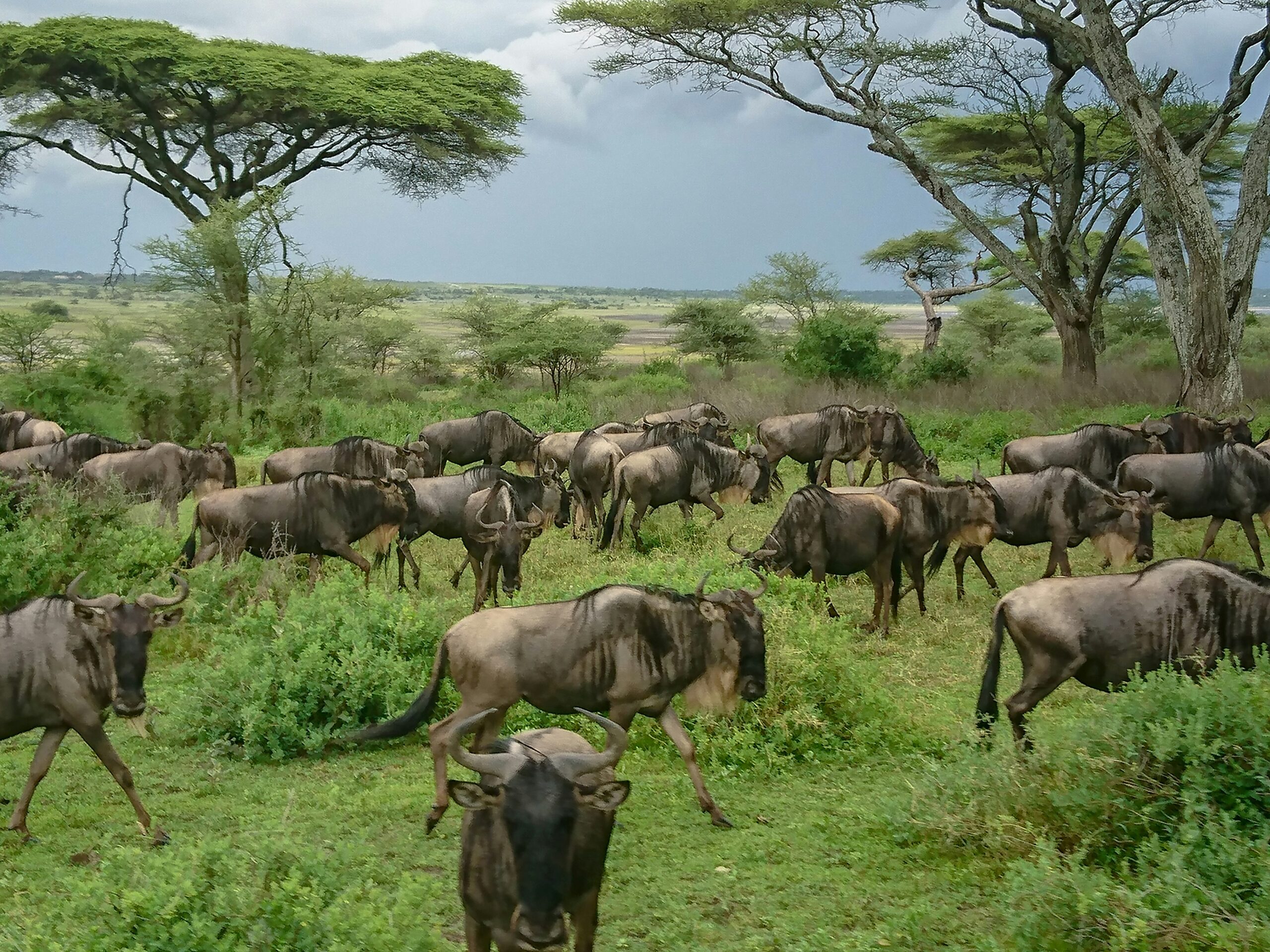
Individual case estimates cited in support include 138 million additional tons of CO2 from restoring forest elephant populations within Congo Basin protected areas. Other claims suggest that Serengeti wildebeest recovery has curbed wildfires enough to capture carbon roughly equivalent to the combined annual emissions of Kenya and Tanzania.

Wildlife’s role in climate mitigation is backed by striking case estimates, including 138 million additional tons of CO2 from restoring forest elephant populations in the Congo Basin and wildebeest recovery in the Serengeti, capturing carbon equivalent to the combined annual emissions of Kenya and Tanzania. Photo by Wolfgang Hasselmann on Unsplash.
The researchers behind the underlying models showing wildlife’s role in climate mitigation are notably more cautious than the headline figures suggest. A follow-up analysis by many of the same scientists, published in People and Nature, states plainly that “a species’ net impact on ecosystem carbon dynamics is context-dependent” and that “the uncertainty around estimates can be high.” In some ecosystems, they note, animals increase carbon storage; in others, they may have no effect or even reduce it.
The original 2023 paper itself acknowledges that scaling rewilding across entire regions “holds large uncertainties,” partly because it requires rebuilding large animal populations over short timeframes in ecosystems that may need to shift entirely, from forest back to steppe grassland, for those populations to be supported at all.
That caveat matters because the field still lacks a robust way to determine whether animal-driven processes are net carbon-negative or positive across the full plant life cycle, something the researchers themselves flag as an open research gap rather than a solved question. Trophic rewilding, in other words, is a promising and increasingly well-evidenced hypothesis for specific species in specific ecosystems, not yet a precisely quantified global carbon budget line item ready for direct accounting.
This is where the consensus statement’s ambition outpaces the underlying data’s current precision. Asking the UNFCCC to formally incorporate wildlife into carbon accounting implies a level of measurement rigor that even the field’s leading researchers say isn’t yet fully established.
That doesn’t undermine the core ecological premise of wildlife’s role in climate mitigation, which is supported by decades of natural history observations. But it does mean policymakers adopting these frameworks will need monitoring systems robust enough to avoid overstating climate benefits attributed to specific conservation interventions, a genuine risk given how directly this science intersects with carbon credit markets and international climate finance.
The political momentum behind the push is real regardless of the modeling uncertainty. The consensus follows pledges by African leaders at COP30 to advance a Wildlife for Climate Declaration, and IFAW has already developed 10 practical recommendations for countries to integrate wildlife into their Nationally Determined Contributions.
Whether that translates into UNFCCC recognition depends on governments accepting not just the ecological logic, which is broadly persuasive, but a quantification framework that its own architects describe as still evolving.
Wildlife’s role in climate mitigation, as this consensus makes clear, deserves a formal place in climate policy discussions that have historically treated biodiversity and emissions reduction as separate tracks. Whether that place should come with confident gigaton-scale carbon accounting attached or with the same cautious, context-dependent framing that the scientists apply in their peer-reviewed papers is the harder question the Bonn announcement leaves for negotiators to sort out.


