


A new wild cat species discovered in Bolivia began its scientific journey when a rescuer mistook it for a lost kitten and fed it noodles, rice, and eggs, only to realize the tiny spotted animal was wild.
The Leopardus tilcayo, now known as the tilcayo tiger cat, represents the first new living feline species formally described anywhere in the world in more than 100 years. This new wild cat species discovered in Bolivia inhabits the Yungas, the lush cloud forest ecotone where the Andes Mountains descend into the humid Amazon basin near La Paz.
The discovery began unceremoniously. A resident living near the forest found the small, spotted animal and assumed it was a lost domestic kitten in need of help. He fed the creature noodles, rice, and eggs, but it failed to thrive on human food and soon began showing distinctly wild behaviors, prompting its transfer to the Senda Verde wildlife refuge once it became clear this was no ordinary house cat.
What happened next transformed a rescue story into a scientific milestone. Researchers initially believed the animal belonged to Leopardus tigrinus, one of several already-recognized tiger cat species found across South America. Genetic analysis told a different story entirely. The new wild cat species discovered in Bolivia proved genetically distinct enough from its relatives to warrant classification as an entirely separate species, resolving what scientists call the tiger cat complex, a long-standing taxonomic puzzle now understood to comprise not one or two species, but five distinct ones.
Paola Nogales-Ascarrunz, who co-authored the study published in Current Biology and leads the Bolivian Felid Research and Conservation Program, emphasized how rare a discovery of this scale is. Finding any new, relatively large mammal remains uncommon in modern science, since most newly identified animal species are small invertebrates or microorganisms rather than mammals occupying visible ecological niches. Her National Geographic-funded conservation work underscored how much remains unknown about wild cat populations even today.
Physically, the tilcayo tiger cat is smaller than an average house cat, measuring roughly 18 inches from head to body and weighing between three and five pounds. Its light brown coat is patterned with dark rosettes, making it look like a leopard shrunk down to kitten size. The species possesses shorter fur than the clouded tiger cat, while its tail is longer and fuller than that of the northern tiger cat yet less bushy than its clouded relative’s, distinguishing features researchers used alongside genetic evidence to confirm its status as a separate species.
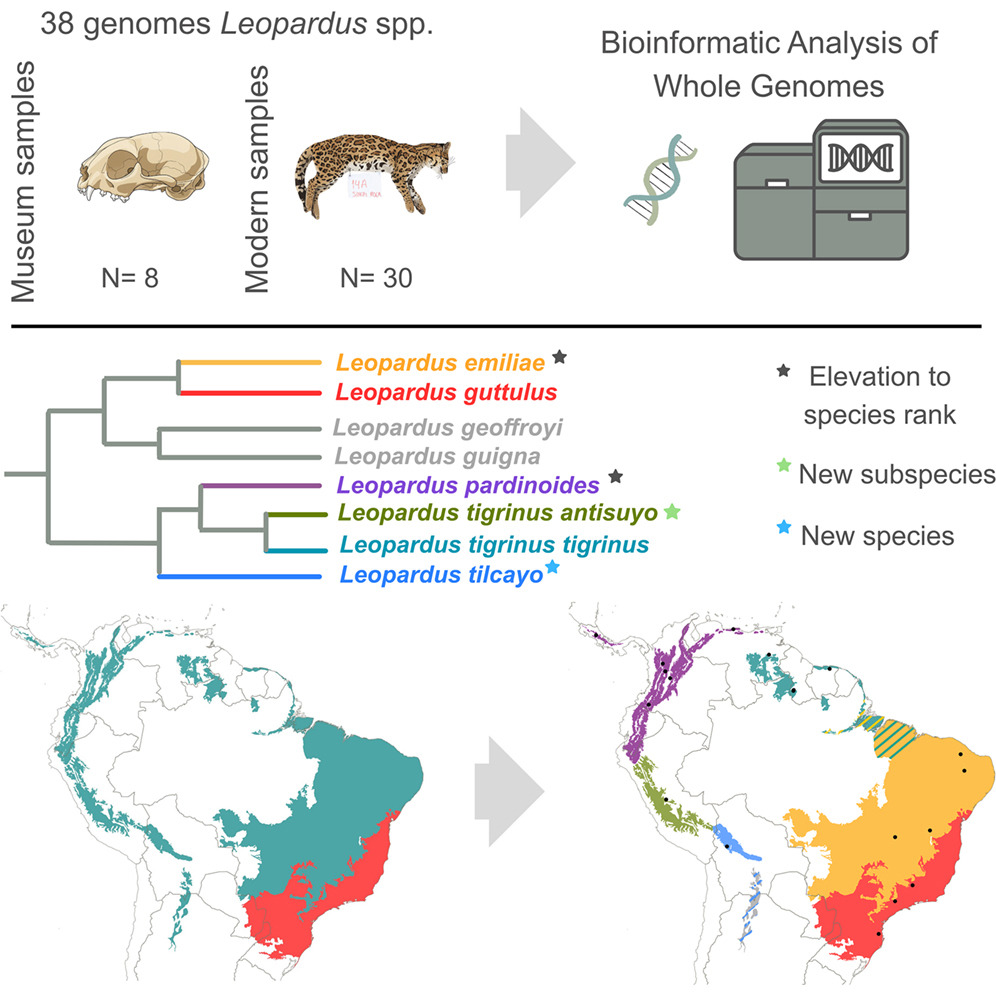
Researchers discovered this new wild cat species in Bolivia through a genomic analysis of 38 Leopardus specimens, combining museum skulls and modern samples to build a phylogenetic tree that revealed Leopardus tilcayo as genetically distinct, along with a newly recognized subspecies and the elevation of two other lineages to full species status. Photo courtesy of Current Biology.
Despite global scientific excitement over this new wild cat species discovered in Bolivia, local communities throughout the Bolivian Yungas have known about the animal for generations, calling it tilcayo long before researchers formally documented it. This disconnect between indigenous ecological knowledge and formal scientific classification echoes a pattern seen repeatedly across biodiversity research worldwide, where species considered newly discovered by international science have often been recognized and named by local communities for far longer.
The implications extend well beyond taxonomic bookkeeping. Scientists currently know very little about the tilcayo tiger cat’s population size, behavior, diet, or broader ecological role within the Yungas ecosystem. Confirming it as a distinct species carries meaningful conservation consequences, since protections and population assessments applied broadly to tiger cats as a group may not adequately address the specific needs or vulnerabilities facing this particular Bolivian lineage.
Conservation organizations reacted to the discovery with a mix of celebration and renewed urgency. Stephanie Allard, Chief Mission Officer of the Dallas Zoo, described the finding as an exciting reminder of how much remains unknown about the natural world, a sentiment echoed throughout the global conservation community following the announcement.
The new wild cat species discovered in Bolivia also highlights the Bolivian Yungas as a biodiversity hotspot that deserves far greater scientific attention and protection. This transitional forest zone, squeezed between high Andean peaks and lowland Amazonian rainforest, harbors ecological communities adapted to its unique elevation gradient and climate, conditions that likely shaped the genetic isolation allowing Leopardus tilcayo to diverge from its relatives in the first place.
As researchers continue studying this newly confirmed species, fundamental questions remain unanswered: how many tilcayo tiger cats persist in the wild, what threats they face from habitat loss or human encroachment, and whether formal conservation status should follow their scientific recognition. For now, the discovery proves that even in an era of satellite mapping and genomic sequencing, Earth’s forests still conceal mammals entirely unknown to formal science, waiting only for the right combination of curiosity, rescue, and careful genetic analysis to bring them into view.


