

Morag Gamble founded the Permaculture Education Institute to train a new generation of teachers and champion permaculture education for regeneration as humanity’s most practical response to the climate emergency.
When Morag Gamble discovered permaculture as a teenager more than 40 years ago, it felt like an immediate natural fit. Not just a gardening method or design technique, but a way of seeing the world in which caring for the earth and people creates ripples of positivity that spread through communities. That conviction shaped every decision that followed, from where she lives to how she teaches to why she believes permaculture education for regeneration represents humanity’s most accessible pathway through ecological crisis.
“Permaculture is a practical and positive way of designing, thinking, living and gardening with abundance and care,” Gamble explained. This expansive definition matters. Permaculture encompasses food systems, water harvesting, energy design, community building, economic resilience, and ecological restoration within integrated frameworks. It treats households and neighborhoods as starting points for systemic change.
Gamble doesn’t simply teach these principles. She demonstrates them daily. For over 25 years, she has lived at Crystal Waters Permaculture Village near Maleny in subtropical Queensland, a United Nations World Habitat Award-winning ecovillage acknowledged for demonstrating low-impact sustainable living. She owner-built her eco-home surrounded by an award-winning edible landscape. Her work, family life, and garden are completely interwoven through permaculture’s connecting fabric.
This integration of teaching and practice defines Gamble’s philosophy. Permaculture education for regeneration cannot be abstract or theoretical. Students need to see regenerative design functioning in real households, real gardens, and real communities before they can carry those patterns into their own contexts. Crystal Waters provides that living laboratory.
The Permaculture Education Institute, based at Crystal Waters in Gubbi Gubbi country, extends this demonstration globally. The Institute offers the world’s first online permaculture teaching program, in which students earn internationally recognized design and teaching certificates simultaneously. But the program’s deeper purpose isn’t certification; it’s multiplication. Each trained teacher represents hundreds of future students who will gain practical knowledge for regenerative living.
“I’m motivated to teach teachers about permaculture and help ripple out a new generation of permaculture teachers around the world,” Gamble stated. “Particularly within the emerging generation and with people whose daily lives are impacted by climate change.”
This multiplication strategy reflects systems thinking applied to education itself. Rather than reaching thousands directly, Gamble trains educators who collectively reach millions. The approach mirrors permaculture’s core principle: design systems that generate abundance beyond what any individual effort could produce.
Permaculture education for regeneration also requires removing barriers to access. Gamble created an ecosystem of free resources, ensuring knowledge reaches people regardless of economic circumstances. Her YouTube channel, Our Permaculture Life, attracts over 125,000 subscribers. The accompanying blog has been accessed around 10 million times. Her weekly podcast, Sense-Making in a Changing World, features leading ecological thinkers. Free monthly masterclasses unpack specific topics requested by followers.
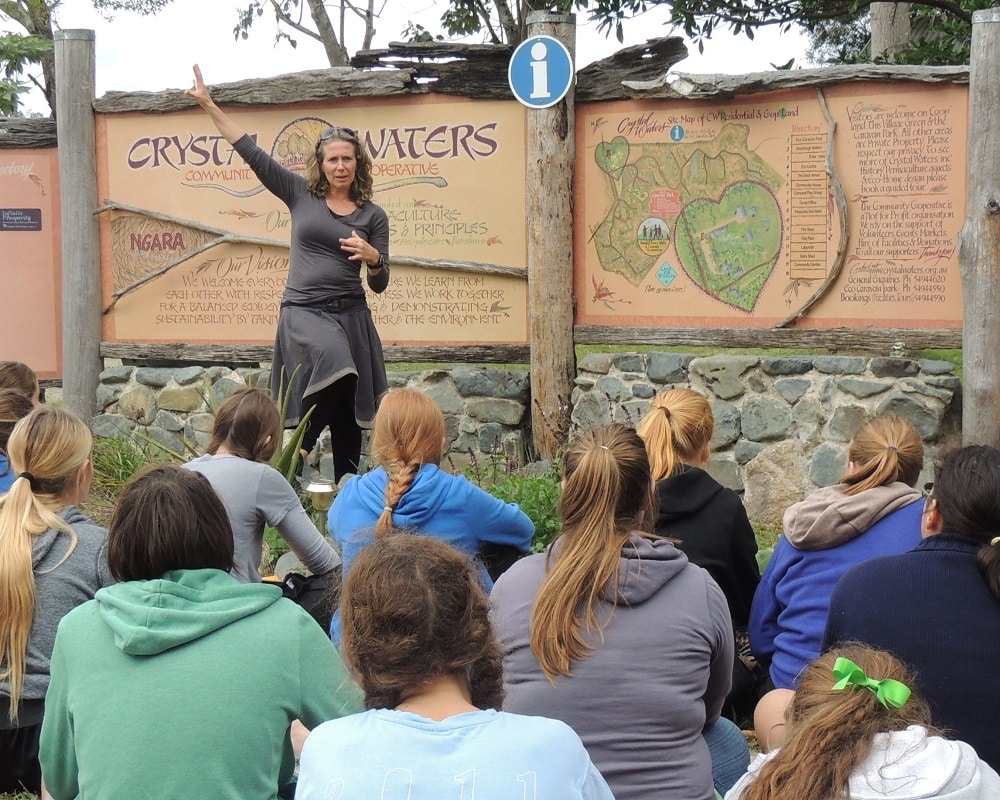
Permaculture education for regeneration reaches far beyond traditional classrooms through Morag Gamble’s freely accessible ecosystem of resources, including a YouTube channel with over 125,000 subscribers, a blog accessed nearly 10 million times, and a weekly podcast featuring leading ecological thinkers, ensuring cost is never a barrier to learning. Photo courtesy of the Permaculture Education Institute
These aren’t supplementary marketing materials. They represent a deliberate commitment to the democratization of knowledge. Permaculture education for regeneration loses meaning if only privileged communities can access it.
That conviction drives Gamble’s charitable work through the Ethos Foundation, providing free permaculture education in East Africa. She witnesses firsthand how industrial farming impacts marginalized communities in Indonesia, India, and East Africa. Supporting women and youth in the global south to access regenerative design knowledge and create resilient communities addresses both climate adaptation and social justice simultaneously.
Permayouth, which Gamble co-founded, creates pathways specifically for young leaders through fellowship programs alongside systems thinker Fritjof Capra, nature camps for teenagers, and Nature Kids programs for children. Engaging young people isn’t sentimental; it’s strategic. The emerging generation inherits the consequences of climate change and needs practical tools to build regenerative futures.
Gamble’s early career revealed how permaculture education for regenerative living transforms urban landscapes. She co-founded Northey Street City Farm, a four-hectare food forest in Brisbane, and the Australian City Farms and Community Gardens Network. These projects demonstrated that even dense urban environments can produce food, build community, and restore ecological function through thoughtful design.
The experience shaped her understanding that permaculture works at every scale. Balcony gardens, suburban backyards, school grounds, community farms, ecovillages, and regional food systems all respond to the same design principles. What changes is the application, not the philosophy.
Teaching invitations from leading institutions across 22 countries, including Schumacher College, UC Berkeley, and the Center for Ecoliteracy, confirmed that permaculture education for regeneration resonates across cultures and contexts. Collaborations with figures including Vandana Shiva, David Holmgren, Janine Benyus, and Rosemary Morrow enriched her practice while expanding networks connecting practitioners globally.
The International Permaculture Festival of Wild and Kind Ideas, hosted by the Institute, embodies this connective philosophy. The festival brings global practitioners together for presentations, workshops, and conversations exploring one-planet living and earth restoration, creating community among people who might otherwise work in isolation.
Gamble’s motivation draws from urgency but is expressed through patience. The climate emergency, social justice, and rapid species extinction demand immediate response. Yet regenerative systems require time, soils rebuild slowly, communities develop trust gradually, and teachers need years of practice before teaching effectively. Permaculture education for regeneration holds both realities simultaneously: urgent action through patient, persistent work.
“I want to help all households and communities to live a one-planet life,” Gamble reflected. “And provide opportunities for young people to be part of a practical revolution. I’m motivated by the climate emergency, social justice, and rapid species extinction.”
The word “practical” recurs deliberately throughout Gamble’s language. Permaculture isn’t an aspirational theory. It’s designing rainwater systems, building healthy soil, growing food, creating community economies, and teaching neighbors to do the same. Revolution happens garden by garden, teacher by teacher, community by community, each one demonstrating that regenerative living works not as a distant ideal but as a daily practice available to everyone willing to begin.


