
In Iceland, Can a Revolutionary New Process Actually Help Stop Global Warming?
As global warming intensifies, causing devastating wildfires and melting ice caps, the urgent need to curb greenhouse gas emissions becomes increasingly apparent. Among the myriad strategies being explored, Iceland emerges as a frontrunner in the pursuit of innovative solutions, leveraging its unique geothermal resources and volcanic geology to pioneer carbon capture technology.
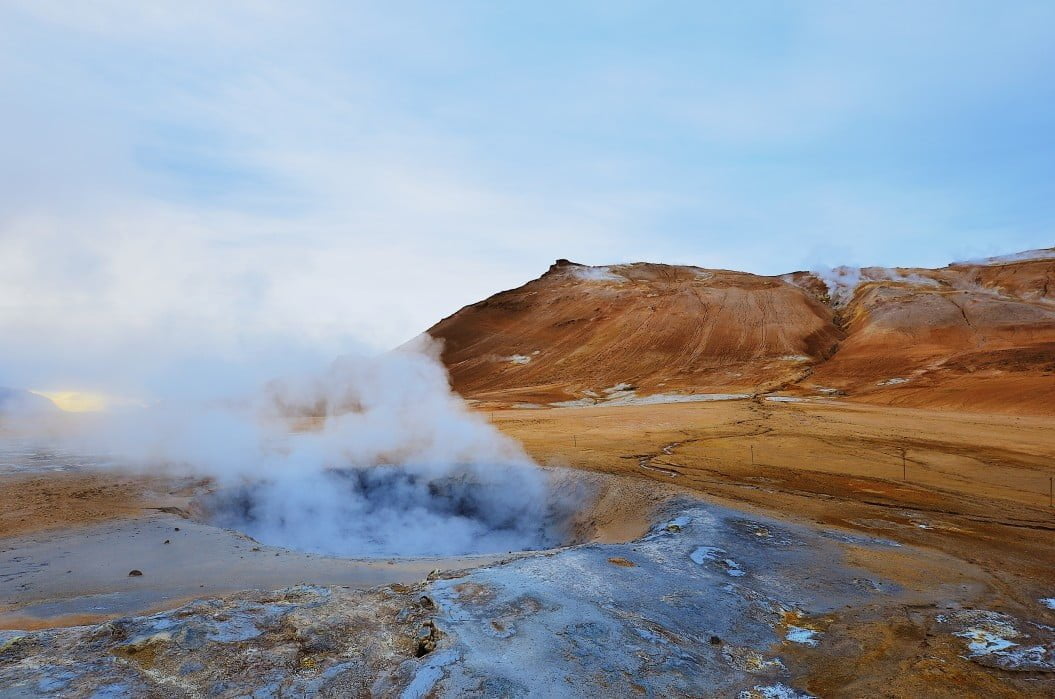
Iceland’s Geothermal Advantage:
Iceland’s landscape is defined by its volcanic activity and abundant geothermal energy, which power much of the nation’s electricity generation. However, geothermal energy production is not without its environmental footprint, including the release of carbon dioxide (CO2) during power generation. Iceland has embarked on a pioneering venture known as the CarbFix project to address this challenge.
At the heart of Iceland’s carbon capture efforts lies the CarbFix technology, a revolutionary process that transforms CO2 emissions into stone.
This CO2-rich water is injected deep underground into porous volcanic rock formations, where an extraordinary chemical transformation occurs. As the CO2-laden water permeates through the intricate network of fractures and pores within the basaltic rock, it encounters a mineralogical wonderland ripe for reaction.
Upon contact with the basalt, a rapid and intricate dance unfolds at the molecular level. The CO2, once a notorious perpetrator of climate change, finds itself entwined in a complex choreography with the minerals comprising the volcanic rock. Through a series of chemical reactions, the CO2 undergoes a metamorphosis, transitioning from a gaseous nuisance to a solid, stable form.
This transformative process, known as mineral carbonation, is akin to nature’s own alchemy, albeit accelerated within the confines of the volcanic underworld. Within a remarkably short timeframe—on geological scales—the CO2 reacts with the calcium, magnesium, and iron present in the basalt, forming robust carbonate minerals. These newly minted minerals, securely locked within the crystalline lattice of the rock, effectively remove the CO2 from the atmosphere for millennia to come.
The result is a remarkable feat of carbon sequestration, where once-looming emissions are transmuted into enduring geological formations. This process not only mitigates the immediate threat of CO2 emissions but also holds the promise of long-term carbon storage, safeguarding against future climate disruptions.
Building upon the success of CarbFix, Iceland unveils the Orca plant, heralded as the world’s first large-scale direct air capture facility. Situated against the backdrop of Iceland’s rugged terrain, Orca represents a paradigm shift in carbon capture technology. Unlike traditional methods that focus on capturing emissions from point sources such as power plants, Orca extracts CO2 directly from the ambient air. This innovative approach not only diversifies the sources of captured CO2 but also holds promise for addressing existing atmospheric CO2 levels. Partnering with CarbFix, Orca ensures the permanent storage of captured CO2 underground, further bolstering its efficacy in combating climate change.
Challenges and Considerations:
While Iceland’s carbon capture endeavors offer a beacon of hope in the fight against climate change, challenges remain on the road to widespread adoption. Scalability presents a significant hurdle, as current technologies must be scaled up to substantially impact global CO2 levels. Moreover, the high cost of carbon capture technology necessitates further research and development to enhance cost-effectiveness. Long-term monitoring is also essential to ensure the safe and permanent storage of captured CO2, mitigating the risk of unintended environmental consequences.
Despite these challenges, Iceland remains steadfast in its commitment to combating climate change. With ambitious renewable energy goals and leadership in carbon capture technology, Iceland serves as a model for sustainable progress. Moreover, Iceland’s success in carbon capture holds promise for replication in other regions with suitable geological formations, offering a blueprint for global climate action.
As Iceland’s carbon capture efforts continue to evolve, they offer a glimmer of hope in the fight against climate change. However, cautious optimism is warranted, as the road ahead is fraught with challenges and uncertainties. Continued research, development, and global collaboration are essential to scale up this technology and integrate it with other climate solutions. With determination and innovation, Iceland’s pioneering spirit may well pave the way for a future with reduced atmospheric CO2 levels and a more stable climate.


